
In today’s visually driven world, colors do more than just beautify—they influence our emotions, decisions, and perceptions. Color psychology explores how hues impact human behavior, a concept that’s been shaping art, design, and marketing for centuries. For brands, understanding color psychology isn’t just an artistic choice; it’s a strategic tool that can boost recognition, evoke trust, and drive consumer actions. This guide dives deep into the history of color psychology and reveals how savvy brands leverage it to stand out and succeed.
Whether you’re a marketer, designer, or business owner, mastering color psychology can transform your branding strategy. Let’s explore its origins and real-world applications.
The Fascinating History of Color Psychology
The roots of color psychology stretch back thousands of years, evolving from ancient philosophies to modern scientific studies. While today we associate it with marketing and therapy, its beginnings were tied to culture, medicine, and art.
Ancient Origins: From Egypt to Greece
Color psychology dates back to around 2000 BC, with ancient Egyptians using colors for holistic healing and mood enhancement. They believed colors like red symbolized life force and vitality, while blue represented the divine sky. The Egyptian word “iwn,” meaning color, also translated to “disposition” or “character,” showing an early link between hues and personality.
In ancient Greece, Aristotle proposed one of the first color theories around 350 BC, suggesting all colors derived from white (light) and black (darkness), relating them to the four elements: earth, air, fire, and water. Greeks and Romans adopted these ideas for medicine, using colors to treat ailments. Similarly, ancient Chinese traditions linked colors to health and harmony, influencing practices like Feng Shui.
The Renaissance and Scientific Foundations
The Renaissance brought more structured explorations. In the 17th century, Sir Isaac Newton revolutionized color theory with his 1666 prism experiments, discovering the visible spectrum: red, orange, yellow, green, blue, indigo, and violet. He created the first color wheel in 1704, laying the groundwork for understanding color relationships.
However, it was Johann Wolfgang von Goethe who shifted focus to the psychological side. In his 1810 book Theory of Colours, Goethe argued that color was subjective and emotional, not just physical. He viewed darkness as an active force and explored how colors affected mood—ideas that influenced artists and philosophers like Arthur Schopenhauer. Goethe’s work marked the first systematic study of color’s physiological and emotional effects.
The 20th Century: Psychology Takes Center Stage
The modern field of color psychology emerged in the 20th century. Swiss psychiatrist Carl Jung pioneered it, calling colors “the mother tongue of the subconscious.” Jung used colors in therapy to uncover emotions and archetypes, linking them to the collective unconscious. He believed innate meanings stemmed from shared human experiences.
Psychologists like Kurt Goldstein expanded on this, studying color’s impact on behavior. By mid-century, color was used in marketing research, with studies showing hues could influence perceptions and decisions. Today, neuroscience confirms these effects: colors activate brain regions tied to emotions, like how red increases heart rate.
From ancient rituals to brain scans, color psychology has evolved into a blend of art, science, and culture. But its true power shines in branding.
What Is Color Psychology and How Does It Work?
Color psychology is the study of how colors influence emotions, perceptions, and behaviors. It’s not universal—context, culture, and personal experiences play roles—but general associations exist.
Common Color Meanings and Emotions
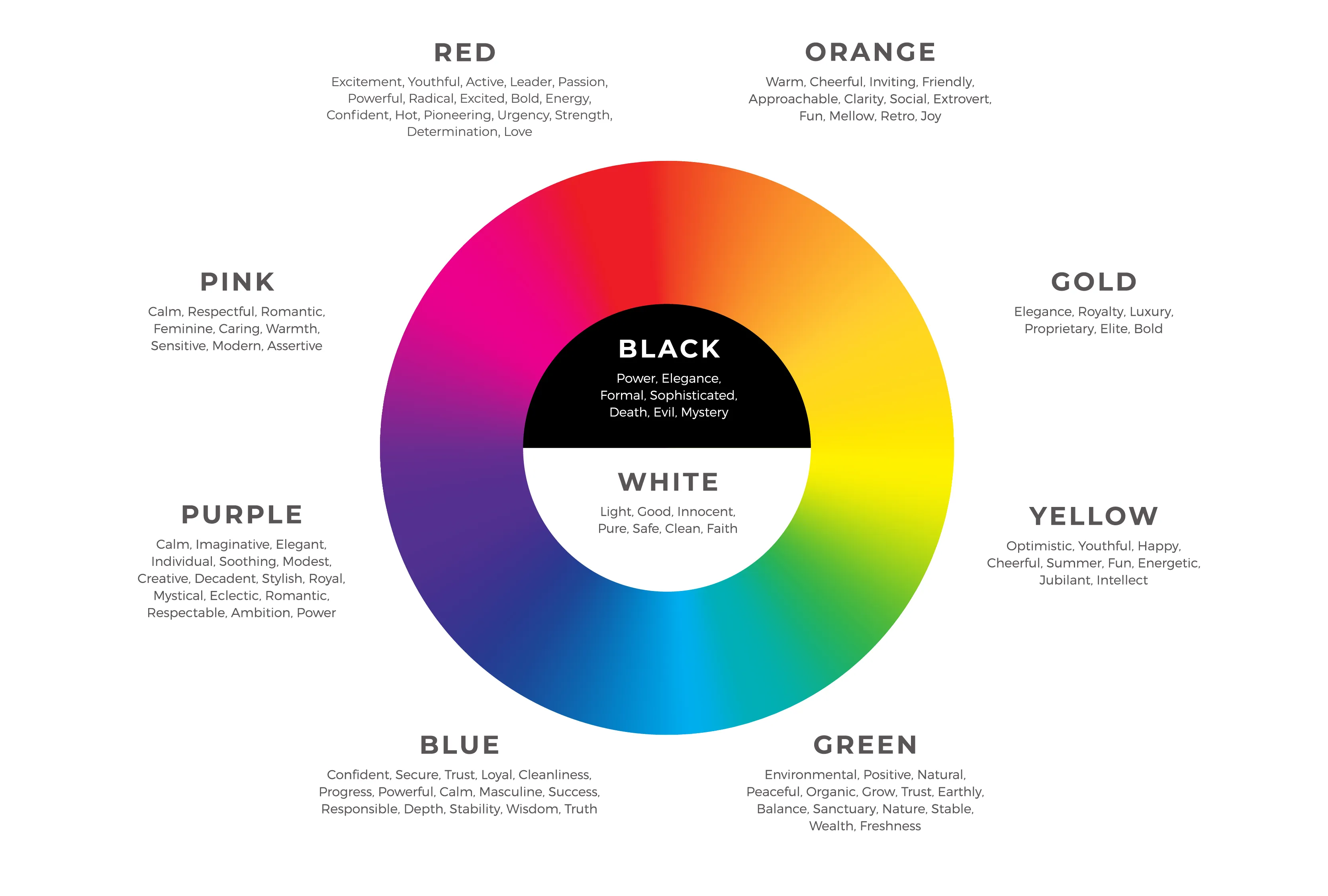
Here’s a breakdown of key colors and their psychological impacts:
- Red: Evokes passion, energy, urgency, and excitement. It can raise blood pressure and stimulate appetite.
- Blue: Symbolizes trust, calmness, and professionalism. It’s the most popular for building reliability.
- Green: Represents growth, health, and nature. It promotes balance and eco-friendliness.
- Yellow: Conveys optimism, happiness, and energy. But overuse can cause anxiety.
- Orange: Suggests enthusiasm, creativity, and affordability.
- Purple: Implies luxury, creativity, and mystery.
- Black: Stands for power, elegance, and sophistication.
- White: Denotes purity, simplicity, and cleanliness.
These associations stem from evolutionary cues (e.g., red for danger) and cultural conditioning. A color wheel helps visualize harmonies and contrasts:
The Psychology of Color | Pyper, Inc.
Understanding these helps brands align colors with their identity.
The Power of Color Psychology in Branding and Marketing
For brands, color isn’t decorative—it’s persuasive. Up to 90% of initial product judgments are based on color alone. It boosts brand recognition by 80% and influences emotions that drive purchases.
Why Colors Matter in Branding
- Emotional Connection: Colors evoke feelings that align with brand values. Blue builds trust for banks; green signals sustainability for eco-brands.
- Consumer Behavior: Red creates urgency for sales; yellow grabs attention for fun products.
- Differentiation: Consistent colors make brands memorable, like Tiffany’s robin-egg blue.
- Cultural and Demographic Factors: Preferences vary—women often favor purple, while Eastern cultures see white as mourning.
Context is key: A color’s effect depends on the product, audience, and culture. Brands that ignore this risk misalignment.
Tips for Brands to Leverage Color Psychology Effectively
To harness color psychology:
- Know Your Audience: Research demographics—e.g., blues for corporate, vibrant hues for youth.
- Align with Brand Personality: Use tools like color wheels to test combinations.
- Ensure Consistency: Apply colors across logos, websites, and packaging.
- Test and Iterate: A/B test designs to see what resonates.
- Consider Accessibility: Ensure high contrast for readability.
- Account for Culture: Adapt for global markets.
Tools like Adobe Color or surveys can help refine choices.
Conclusion: Unlock Your Brand’s Potential with Color Psychology
From ancient Egyptian healers to modern marketers, color psychology has proven its enduring power. By understanding its history and applications, brands can create emotional connections that drive loyalty and sales. Whether revitalizing your logo or launching a campaign, thoughtful color use can elevate your presence.








Great content! Keep up the good work!